Tuesday, December 6, 2016

Ideal Readers: My Students Give ME Writing Feedback!

After following Kimberley Moran's journey with the Institute of Children's Literature's Writing for Children and Teens writing course, I decided to give it a go myself.

My first assignment was to write a 500 - 750 word story based on one of three pictures. I wrote and wrote -- and rewrote and rewrote -- my story.. Finally, I had a finished product that satisfied me, but fell short of thrilling me. I wasn't sure exactly what about the story didn't sit right with me, but I knew there was something.

Lucky for me, I teach a room full of ideal readers (10 year olds) that could help me out by reading my story and giving me their feedback. Problem solved!

In our classroom, we provide writing feedback using the TAG method:
   
Tell something you like
Ask a question
Give a suggestion

When a student finishes a piece of writing, they find someone to "TAG" it. Reader feedback can be so valuable to a writer, and we have spent a lot of time learning how to give meaningful feedback that can help the writer make revisions. (In other words "I like it" and "This was good" are not helpful.) 

So on Friday, it was my turn to have my writing tagged by 20 readers.

It was the best move I could have made.

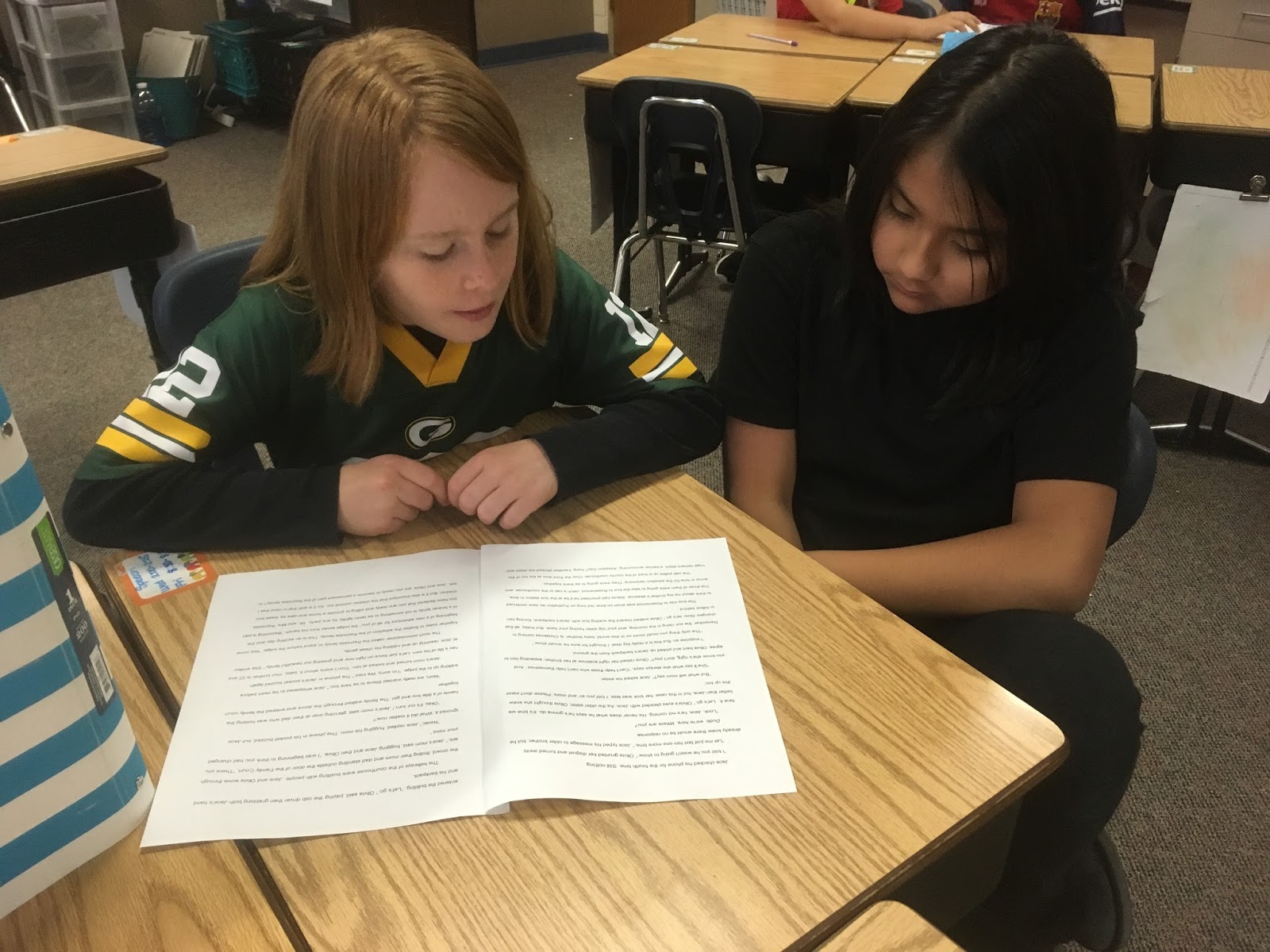
My students worked in partners to pour over my writing. They knew how important this course was to me and asking them to participate in making it a successful experience was a job they took very seriously.

After about 20 minutes, I called the group back together to give me their feedback.  They noticed some amazing things about my writing that had even slipped past me. The questions they asked and suggestions they made were both thoughtful and helpful. I now realize what it was that didn't quite sit right with me and have a plan to fix it in revision.


But sharing my writing and asking my students for help did more than just help me improve my writing.

It empowered my students.

A win-win for all of us.


Tuesday, November 29, 2016

The "Special" Bookshelf

There's a bookshelf in our classroom, right next to my desk, where I keep my "special" books.

These are the titles that have grown near and dear to my heart throughout the years. The ones that I reach for when a student says, "I don't know what to read." The ones that I often look to when I am looking for a new read aloud.


At the beginning of the year, only a few students will wander over to my shelf to ask if they can borrow one of the books. But lately, more and more students have been doing so.

I like that.

It tells me my students and I have connected as readers.

Yesterday, one of my boys got very excited when he found Kwame Alexander's Booked on my shelf. He asked if he could borrow it. At the end of our reading time, he came back to me to tell me how much he loved the book so far.  He opened the dust jacket and read me the words that printed there as a teaser. "Isn't that awesome, Mrs. Laffin? I just love the way he writes."

Yes, it is awesome.

Books, "special" or not, are powerful things.


Saturday, November 12, 2016

Messing Around

We are finishing up a round of Genius Hour projects, getting ready to share our learning with each other. I asked students to prepare their projects for a three to five minute presentation. One boy decided he wanted to create an iMovie for his project, but said he didn't know how.

"Okayyy....," I told him a bit nervously, "I'm not very familiar with iMovie, but let's give it a shot."

I handed him my iPad and told him we could create a practice video together. To gather footage, he went around the school looking for places where math concepts were being used and put together a short video. We worked together to learn how to import clips, add photos, and edit his video snippets. He was pleased with his test project and made plans to take video for his Genius Hour project.

When he returned to Genius Hour class yesterday, he had his video recorded and saved to his Google drive -- All 15 minutes of it in one continuous clip.

"Can you help me edit it?" he asked. "There's some stuff I need to take out."

Together, we figured out how to load his (very long) video into iMovie.

"Hmmm...I'm not sure how to edit something in the middle of a clip," I told him. "We could Google it." (Google is one of my favorite teachers.)

"I still have my video in my Google drive just in case. Should I just mess around and see what I can figure out?" he suggested.

"Yes! Great idea!" I told him, slightly relieved. "Sometimes we just have to mess around with things until we figure them out."

He went off to his desk, putting his headphones on so he could hear the audio without disturbing others. He was super focused on the task at hand, determined to figure it out. Soon, he was next to me, teaching me how to use the "clip" button to edit footage within a video.

He was quite proud of himself. (I was too!)


This got me thinking.

How often do we allow our students time to just "mess around" with their learning?

Probably not often enough. 

We are so driven to get them to their learning destination that we forget the joy in the journey. We don't have time to allow kids to wander off the lesson plan path to see what new discoveries they can find. This kind of learning is messy. It may require us, the teacher, to admit we don't know something.

But that's okay.

This student reminded me that sometimes messing around with something is the best way to learn about it. I could have taught him exactly what to do, (after I Googled it, of course), but chances are he wouldn't have learned as much from me as he taught himself.

My goal is to introduce more messy learning whenever I can. To be okay with telling a student I don't know something, but that we can find it out together. To allow my kids to explore and learn from mistakes, then teach others what they've found.

This can be the best kind of learning.

And a good reason to celebrate.


Tuesday, October 25, 2016

Why They Write

Last Thursday, the National Day on Writing, I asked my students to think about what writing meant to them and how they use it every day. To gather our thoughts together, we created a Padlet with each student answering the prompt of the day, "Why do you write?"

I'll admit, I was a bit nervous for their answers. I was worried that they would all say they write because they have to, because I tell them to, because if they don't, their grades will tank.

Imagine my joy and the thrill I felt when I looked over their Padlet:
Seeing their words and hearing their conversations about this topic made this teacher's heart happy.

It showed why it is so important to take time for writing every day. Why we must give our students the time to explore their thoughts, their wishes, and their wonderings (and the occasional letter to Santa).

This is my wish for all of us -- teacher and student alike.

Thursday, October 20, 2016

Why I Am A Teacher Who Writes

Because I am a teacher who writes....

I understand how difficult it is to sometimes bring words to the page.

I know how important it is to connect with an authentic audience.

I can show my students how to take their writing to the next level.

I can share my own writing struggles and celebrations with my students.

I can share the magical feeling that comes from finding just the right words to say what I wanted to say.

My students see me as someone who walks the walk.

I find writing tricks that I can pass on to my students.

I understand that the writing process is not a straight road, but rather route filled with zigzags, detours, closed roads, side trips, tourist sites and rest stops.

I can use my own writing as mentor texts.

I can have my students teach ME about ways to make my writing better. (Instant engagement!)

I have connected with some amazing educators who also write. This has made me not only a better teacher, but a better person.

Today, October 20th, is the National Day on Writing. I hope you'll take a moment to celebrate by writing with your students today.


Tuesday, October 18, 2016

Goals: Allowing Time to Make Them Happen

Last week, I read this post by Two Writing Teacher's Betsy Hubbard about student goal setting in writing. (If you haven't read it yet, stop right now and go check it out.  It's a must read.)

Betsy's post was like an A-HA moment for me.

I'm no stranger to student goal setting, but setting goals in writing has always been a fuzzy activity for me. What constitutes "good" writing? When students look at their own work, will they be able to identify their deficits? Their strengths? How can we move past the "capitalize letters" and "write neatly" goals to the more 5th grade appropriate "stretch out the important parts" and "use dialogue to move the story forward"?

But after reading Betsy's post, I was able to work through goal setting with my student writers. We looked at an example of strong 5th grade writing from Lucy Caulkin's Writing Pathways book and identified what worked in the piece. Then we looked at our own writing to see how it compared. From there, my students set goals for themselves for their next narrative piece.

What was the biggest "A-HA" for me from Betsy's post was her idea of dedicating the final few minutes of writing time to have students go back in their writing and focus only on their goal. If their goal was to mix up their sentence structure, they had the time to make sure that was happening. If they didn't see evidence of their goal, they added it right then and there.

Too often, I find that I get so caught up in the setting of the goal that I forget to allow time for my students to actually work on that goal. It's like I expect the achievement to magically happen! A few minutes of writing time dedicated to making those goals come to fruition is well worth it. It will result in my students becoming more accomplished writers and will make goal setting actually mean something.

Thanks, Betsy!


Monday, October 3, 2016

Homework: Why I Share the Answers

There is a lot of debate out there on the grading of homework. You can easily find reasons to support all sides of the  issue.

I'll begin by saying that I am not a fan of homework.

After researching and teaching my students about growth mindset, I am even less of a fan.

In my classroom, our focus is on the learning. Mistakes are welcome -- they are proof we are trying. Figuring out what we did to make those mistakes and taking steps to ensure it doesn't happen again is growth.

Growth mindset teaches us that our brains are always changing and growing. By trying new things, showing grit and perseverance, making mistakes and trying again, we are changing the physical structure of our brains for the better.

This does not work if I grade every assignment my students do.

They would be afraid to make mistakes.

They would hesitate to ask for help.

They would shy away from trying new things because they can't do it perfectly the first time.

So when I assign practice in math, my answer key is always open for students to check their answers. If we use a worksheet, I will often copy the answer key right on the back of the page. Sometimes, I just write the answers on the board. If my students got a problem wrong, they go back and fix it. If they can't figure out what they did, they ask for help.
This has built more confidence in all subject areas, but especially in math.

It has also helped me correct misconceptions before a student has done 30 problems incorrectly and has the incorrect procedures cemented in their brain.

So what do I grade?

The test.

Which, ironically, makes students try harder on their practice work, thereby increasing their learning.